Search This Blog

Friday, March 14, 2014

Sizing up For Plus Sizes

Sizing up For Plus Sizes

I use the method Barbara Deckert uses in her book Sewing for Plus Sizes. If you are plus size or regularly sew for someone who is I highly recommend this book.

You will need to take your measurements, the pattern size, and the amount to be adjusted. To find this take your measurements, the pattern measurements, and figure out the total change, some may be down so don't worry about that. Write down your calculations making sure to use a plus or minus sign to denote adding or subtracting width.


Your measurement
Pattern Size
Amount to Be Adjusted
Adjustment per Seam
Bust


Waist


Hips


Once you have calculated the amount to be adjusted count the vertical seams excluding the center front and center back. On this dress with just a front and back there are 4. Divide the amount to be adjusted by the number of vertical seams (4 in this case). If your fractions end up strange round UP to the nearest 8th. This amount is how much you will add or subtract from the cutting line. Mark each adjustment at the bust, waist, and hips on each seam and trace a line from each mark to the next. Its best to do this in a colored pen so you will see your lines.

Helpful Hint: If your adjustments are over 10 inches, counting the center back and center front will help keep the balance of the design. They would count as 4 more edges.


Preparing to Cut

Before cutting the fabric there are some things you need to do.

First off you should preshrink your fabric. Do this by washing and drying the fabric the way you plan to launder it once its made. Some fraying is normal, just work around it.


Next you'll need to straighten the grain. You can test the grain but almost all fabrics are a little bit off so its easiest to just straighten it. Do this by pulling diagonally on opposite corners, then pulling diagonally on the other set of corners. Like this:

You should also true the pattern if its fitted and you aren't sure about how it will fit. This pattern is very basic and loose so you won't need to do that with this one. We'll do that with the next tutorial.

Next cut out the pattern with a separate set of scissors, using your fabric scissors on paper will dull them faster. If you want to keep the pattern in tact you can use tracing paper and a wheel to trace the correct size OR you can fold at the cutting lines and snip through the curved areas (this is the easier method and the method we'll use this time). If you vary from sizes you can trace from the cutting line at one size to the cutting line of the next size. If you want to be able to use your pattern with multiple sizes you can fold the straight lines and clip in and fold on the curves like so. I have left a couple of places on the armscye unfolded so that you can see how it is clipped. If you need to use a larger size you can just unfold it back.


Helpful Hint: All the major pattern companies mark cutting lines but some independent companies mark seam lines. Always double check whether seam allowances are included and if so how wide they are.
  

All those symbols: Translating pattern symbols

Before we go anywhere else there is something beginners should know... what on earth do all those symbols mean???

You probably noticed in my previous post that the symbols are pretty short on explanation.

First off are the cutting lines. Some patterns use a single solid line for cutting lines (this one does). Some have a series of dashed lines, each indicating the next size down like these.
Typically on multisized patterns seam lines are NOT indicated. On single size patterns typically the solid line is the cutting line and the dashed line is the seamline. Cutting lines tell you wear to cut for a 5/8" seam line. If you would like a larger seam allowance you'll need to cut excess and mark your seam lines. If you are new to sewing its best to trace over your size with a felt tip marker or colored pencil. 

Next up are grainlines whole articles have been written about grainlines. They look like a line with an arrow on either end. On most patterns grainlines are either lengthwise (parallel to selvage) or bias (at a 45 degree angle to selvage. 


To make sure you are on grain you should use a ruler and measure from one end of the grainline to the selvage, then the other end of the grainline to the selvage. When the measurements are equal you are on grain. (Pictures will follow on cutting the pattern).

Last for the layout symbols are fold lines. They are a bracket with arrows pointed on either side to the side that should go "on the fold" The on the fold edge is never cut. To create the fold line put selvages together, the opposite side is where your fold line is. 

Next up are fit and alteration symbols. There are only two of these and they indicate fit points and where you should lengthen and shorten the pattern if necessary. 

The bust and hip indicators look like crosshairs for a target. This is where the circumference (remember the finished fit measurements?) for the finished item are measured from and this is where you would adjust width wise for enlarging plus size clothes. 

Then there are lengthen and shorten guides. These are two parallel, solid or dashed lines and should say lengthen or shorten here. These are where you would adjust for a shorter or longer waist, etc. 

Last are the assembly symbols. 

The most common are pattern notches, either one or 2 sides by side. They generally look like either a triangle or diamond on the cut line. These indicate where to match the seam lines. You will need to mark these on your fabric. There are a variety of ways to do this but the easiest is just make small snips with your scissors in the middle of the triangle. 

Another common symbol are dart symbols. Typically they look like a triangle with a small solid dot at the top, sometimes they look like a diamond with a small solid dot at either end. Darts will need to be marked as well and you will fold them over aligning each side and sew them. 
Darts usually originate from the waistline but there are many, many places a dart can be. Here are just a few

Depending on your pattern you may have markings for buttonholes, pleats, tucks, gathers, markings for pockets. 

Buttonhole marks look like a sideways I and indicate the placement and size of buttonholes. Button marks are an X and indicate placement of buttons.

Pleats, tucks, gathers, and markings for pockets generally have a solid dot to indicate and end point and a dashed line to indicate sewing lines. Our first pattern uses pleats so we shall see an example later in the construction.

Disclaimer: This doesn't include anything you'll ever see... please ask questions if you need to.

Deciphering Pattern Instruction Sheets

Pattern instruction sheets contain all the information you need from what to cut, to how to sew it together.

First up on most pattern instruction sheets are more line drawings with the letter labels.

Next are pattern pieces. Each line drawing will have a number, and under the drawings the numbers are listed and named. They will have letters beside them (ie A, B, C) corresponding to which pattern it goes to. In this case we will be cutting numbers 1- 6.


Depending on the layout next up is either the cutting instructions and layout or the general directions. You should always read the general directions first. These contain the pattern symbols, standard seam allowances, lengthening and shortening instructions, etc.

Last, before the sewing instructions is the cutting layout. These typically include a layout for 45” and 60” fabric. Fabrics are cut right (pretty) side UP for single layers and right sides together (wrong side out) for double layer (patterns that require cutting on the fold). (Note asymmetrical designs MUST be cut in single layers with right side up)


After the cutting layout are the actual construction steps but first we have to prepare our pattern and fabric, then cut it out. 

Understanding the back of the pattern envelope

Understanding the back of the pattern envelope.

You will need to find your size on the back of the pattern and buy the appropriate materials.

This is the time to become familiar with the back of the pattern envelope, there is a LOT of information on the back of patterns so here is a run down of what you will find.

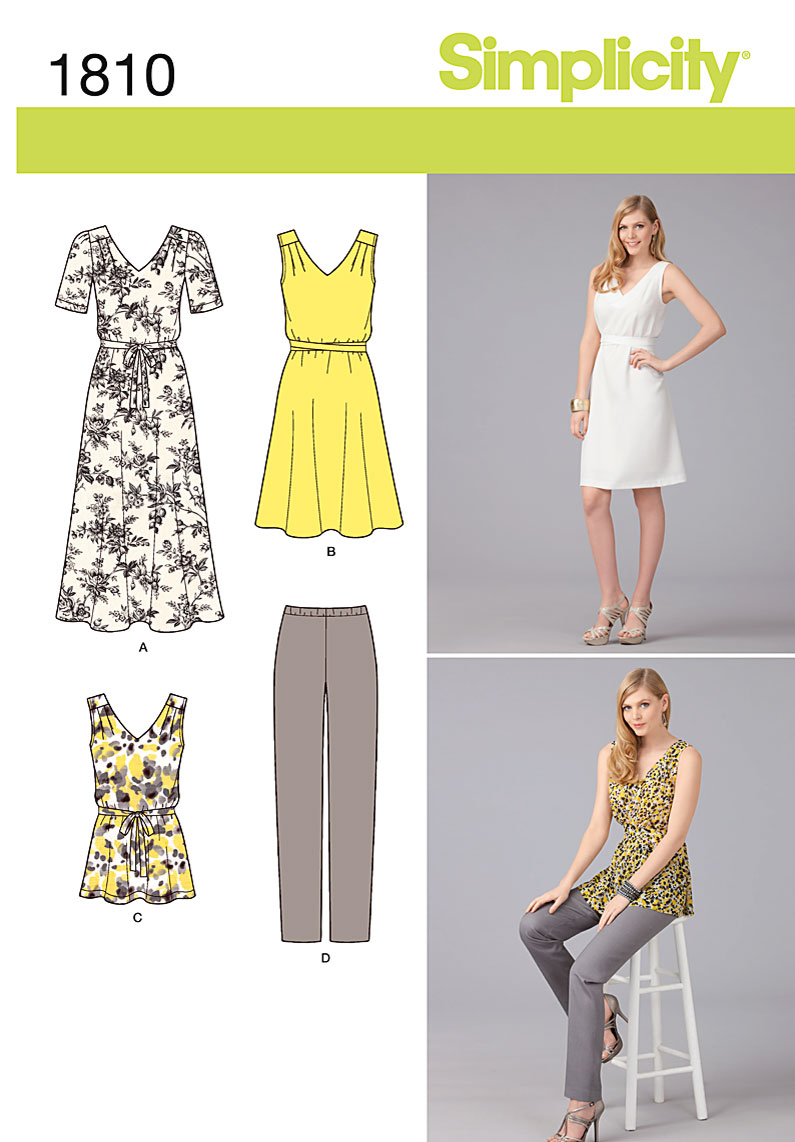
Pattern number and number of pieces: 4 numbers denoting the style for that pattern company and how many individual pieces there will be once cut out. In this case 1810 and 9

Line Drawing: black and white drawing of each of the garment options labeled with letters to denote which is which.

Fabrics: what fabrics are suitable and what may not be

Notions: What items other than fabric you will need from the fabric store. For view B you will need thread and 1 package of 1/2” wide single fold bias tape.

Body measurements and pattern size: we already covered pattern sizes and measurements earlier in this case the measurements are still the same but its offers XXS to XXL. You just need to find your measurements and look down to see what they correspond to.

Fabric measurements for each style: This tells you how much fabric to buy in either a 45” or 60” fabric. Be sure to check the ends of the bolts to make sure you're getting the correct size. Also included under this is how much and what type of interfacing you should purchase. In this case it specifies 5/8 yd of 20-25” lightweight fusible. When in doubt the weight of your interfacing should match the weight of your fabric.

Last but not least finished garment wearing measurements including ease. Ease is very important, if you make a pattern the exact same size as your measurements it will be too tight and maybe rip the seams. Minimum wearing ease is 2-4” in the bust and hips and 1” in the waist. Remember this is a minimum and this design is a loose fitting dress. For this, the finished bust measurement for a 38” bust is 42”

In yellow I have highlighted the size and corresponding amounts of fabric you need for the size we're making. If your size varies just find your measurements, look down to option B and find the amount of fabric you'll need.

Note for ease of use and viewing I have cropped out the side that isn't in English. 

Getting Started

We will be working with Simplicity 1810 for this. These posts can be printed out and maybe be used with permission.

Getting Started

Before you begin working with your pattern you will need to collect these items, if you haven't worked with a pattern before please read this post before buying your pattern and materials:

-Pattern

-Fabric

-Interfacing

-Pins

-Scissors

-Measuring Tape

-Marking method (I recommend Pilot Frixion pen which irons off) you can use tailors chalk, marking pens, etc make sure you test them and the removal method to ensure they don't stain.

The first step is to have someone take your measurements so that you know the correct pattern size. Pattern sizes do NOT go by ready to wear sizes. You will need 3 measurements bust, waist, hip. Be aware for ladies that patterns are meant for a B cup, if your breasts are larger you will need to use an upper bust measurement. Because most people don't fit the exact sizes given by pattern companies for dresses and blouses it is usually best to select based on bust measurement (or upper bust if over B cup) for pants and skirts it is best to select the hip measurement and adjust up or down for the waist.

Bust measurements are taken at the widest point of the bust, wherever that may be.

Upper bust or high bust measurement is measured just under the arms around the upper bust

Waist measurements are at the wearers smallest point.

Hip measurements are taken at the widest point across the hips and bust.


Write your measurements below

Bust


High Bust


Waist


Hip


Its best to write your measurements down and be sure to recheck every 3-4 months as changes can slip up.

Luckily most pattern companies go by a standard sizing chart (unlike ready to wear) so your sizing on a Simplicity pattern will be the same as that on a Vogue pattern. We will address sizing up for plus sizes later if your size is over this just buy the largest pattern size offered. Remember since making a dress select for bust or upper/high bust and we will adjust based on that. 


A little explanation


I started this blog after being inspired by a beginner group on facebook. A lot of people have wanted to get started sewing and maybe even have a machine but don't have a clue what to do next. Some are too intimidated to touch it, some have done some basic things but then are afraid of paper patterns. I hope to help people conquer these fears by posting useful information, tutorials, links, and videos.

The most requested item has been how to sew with patterns. That's what I'll start out with. I do have plans to add other beginner projects AND individual techniques and trouble shooting issues.

To start out with we're going to make Simplicity 1810 option B (the yellow dress). No sleeves, no fitting, and no closures make this a super easy beginner pattern.


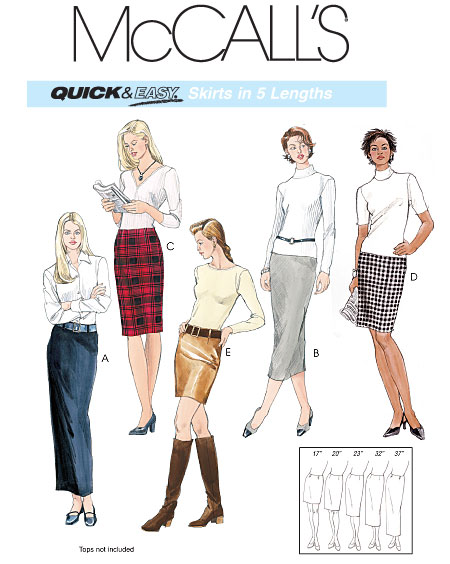
Next we'll move on to McCalls 3830 a basic pencil skirt. Here we'll learn the basics of fitting, how to sew darts, how to insert a zipper, how to put in a lapped zipper, how to hem a skirt using hand hemming and machine blind hem stitch.


Finally we'll make Vogue 8772 a basic women's blouse. This will teach more complex fitting, set in sleeves, cuffs and collars, 1 step and 4 step buttonholes. 

Hopefully some of you will create with me, if not I hope you enjoy watching the process and learning lots. Feel free to post questions in the comments section.